Meghalaya
Abode of Clouds: Transparent Dawki River Boating & Cherrapunji Falls
- Nature
- Adventure
- Luxury
- Honeymoon
- Scenic
- Culture
Meghalaya, your way.
With time for what matters.
The Northeast India Nature Circuit (Guwahati → Kaziranga → Shillong → Meghalaya) covers 700km of the most ecologically and culturally distinct territory in India — the Brahmaputra floodplain (Kaziranga, home to 2/3 of the world's one-horned rhinoceros population), the Khasi Hills (Meghalaya — "abode of clouds," wettest region on Earth, matrilineal Khasi society), and the Brahmaputra's confluence city (Guwahati — Kamakhya Temple, Brahmaputra boat ride). July 2025: Meghalaya circuit — Guwahati, Shillong, Cherrapunji, Nongriat Living Root Bridges, Mawlynnong, Dawki Umngot River.
Is This Circuit Worth Visiting in 2026?
Why visit Meghalaya.
Why Northeast India Nature Circuit 2026? Because nowhere else in India puts the world's densest one-horned rhino population, the world's wettest place, bridges grown from living trees over 500 years, and the clearest river in Asia within a single 10-day drive. The Northeast India circuit is the most ecologically and culturally distinct domestic travel experience in India, and it remains significantly under-visited by mainland Indian tourists relative to its extraordinary natural content.
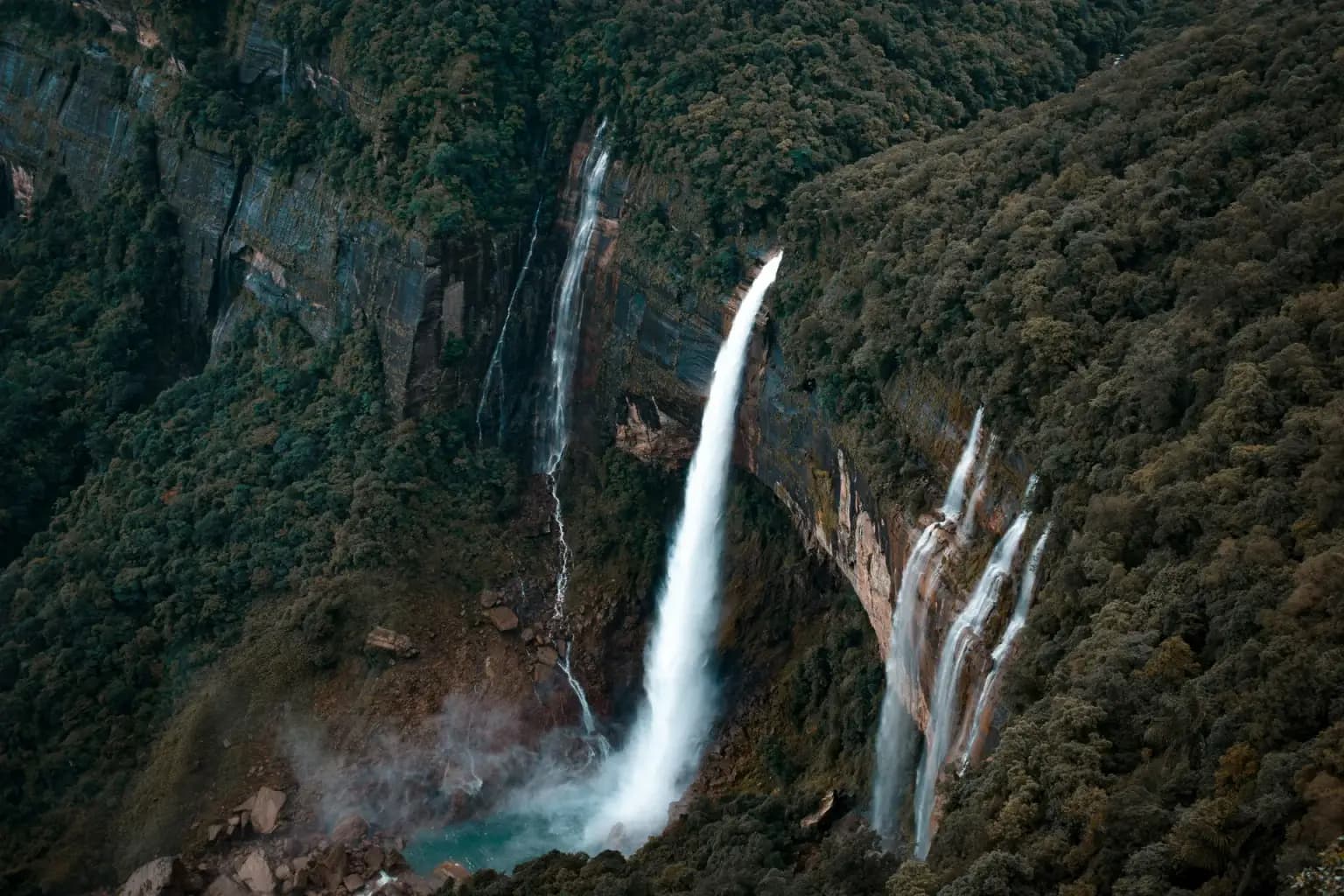
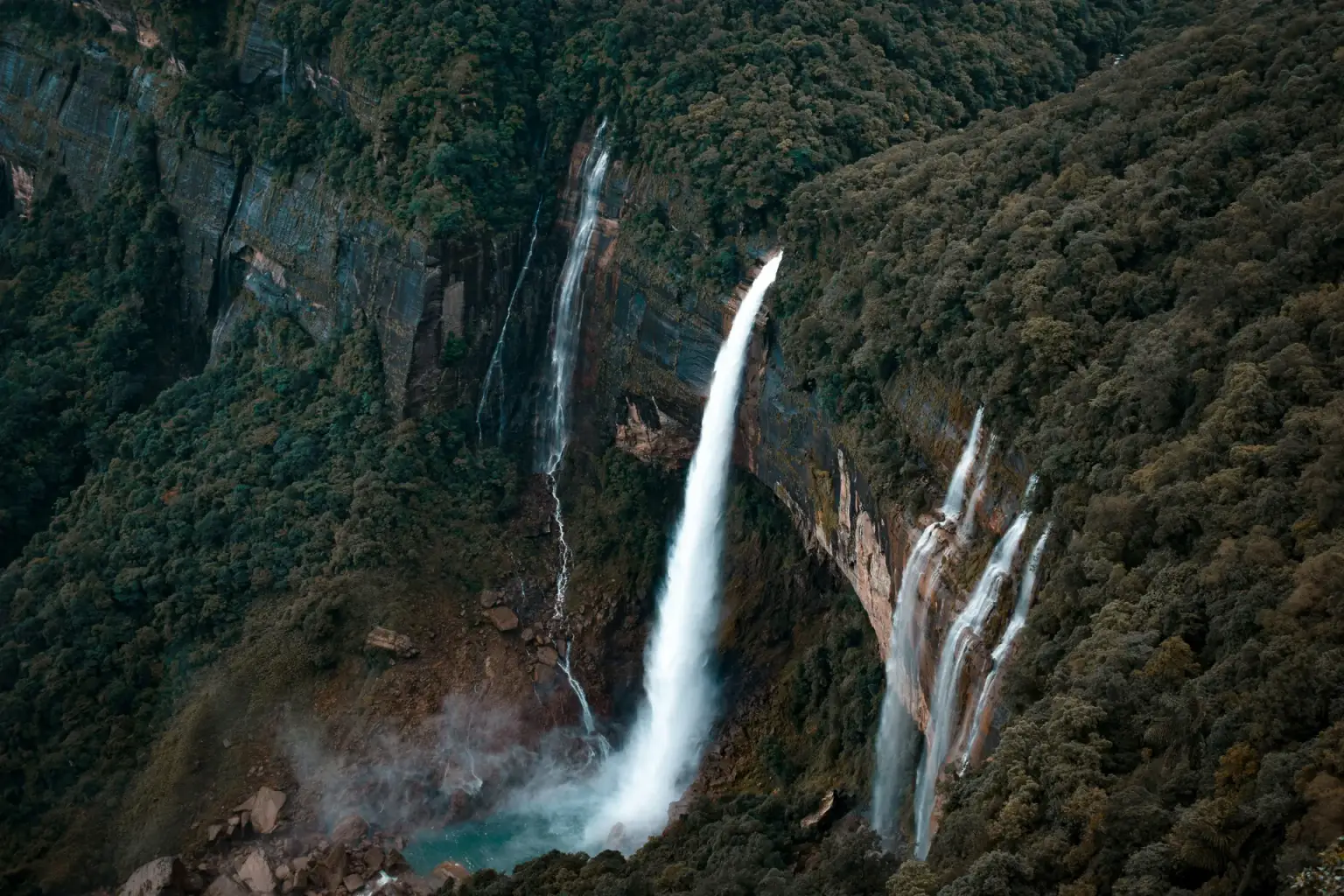
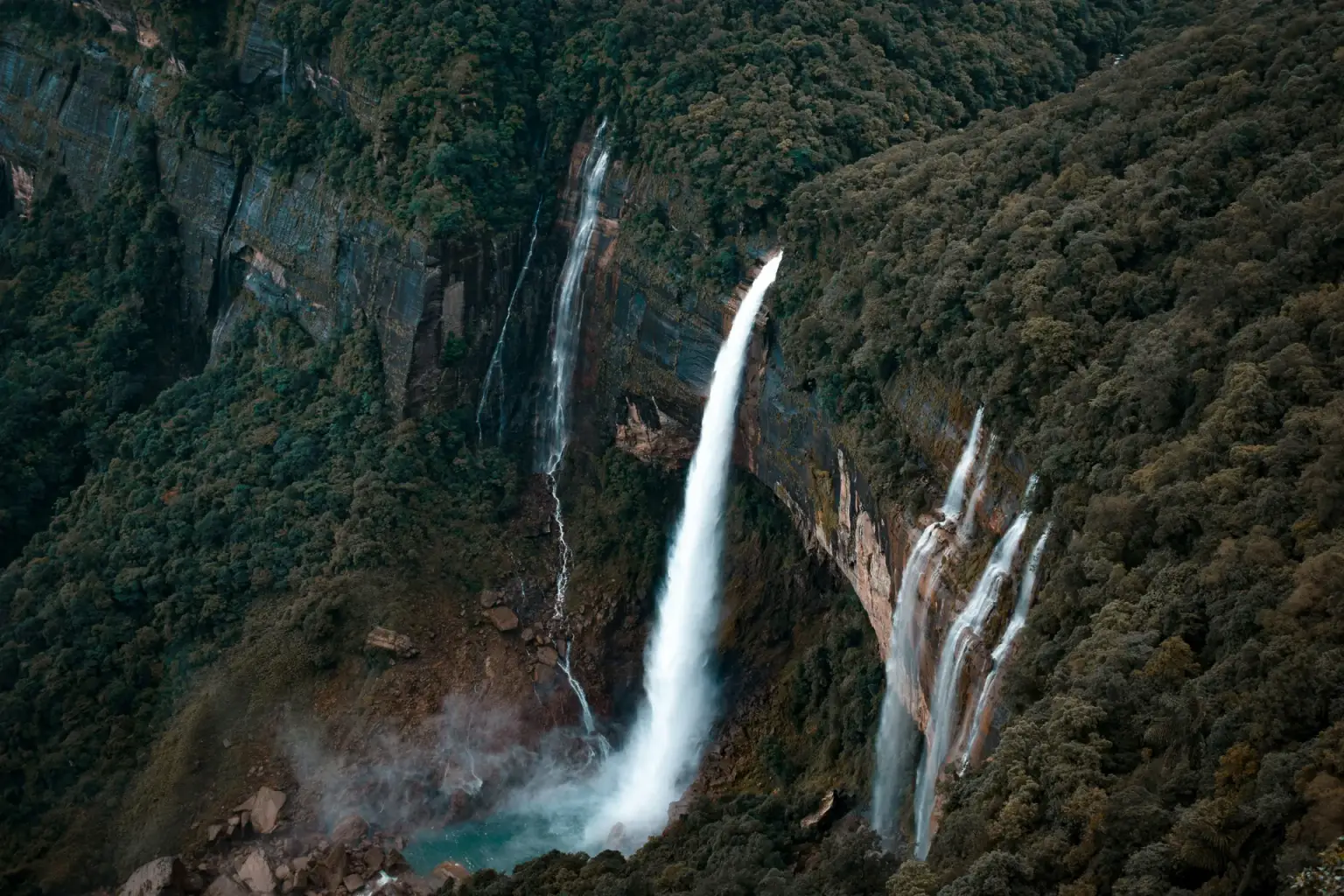
On July 14, 2025, I stood at the viewpoint above Nohkalikai Falls in the full Cherrapunji monsoon. The falls drop 340m free without touching the rock — the water launching from the plateau edge and arriving at the plunge pool in the valley below as a continuous, thundering white column. In July, the monsoon turns this waterfall from impressive to overwhelming — the sound before the falls are visible, the mist 200m before the viewpoint, and the specific blue-green of the plunge pool below that comes from the copper in the rock staining the accumulated water. I have stood at the Chitrakoot and Dhuandhar and Dudhsagar falls. Nohkalikai in July is in a different category. The scale, the free-fall quality, and the monsoon power together make it the most physically affecting waterfall in India.
The Living Root Bridge at Nongriat required 3 hours of descent into the gorge from Tyrna village — 3,200 stone steps, increasingly humid, the jungle closing in above the path. The double-decker bridge appeared suddenly at the bottom of the final descent: two bridges, one 1.5m above the other, both woven from the same tree's root system that has been growing since the 15th century. I stood on the lower bridge and the upper bridge was at eye level. The roots underfoot are not dead wood — they are living tissue, still growing, the bridge still strengthening year by year. The specific experience of standing on something living that is also a functional structure that is also 500 years old has no equivalent in any Indian destination I have visited.
Key features of Meghalaya
Top 8 Places in This Circuit 2026
Kaziranga National Park — Rhino Country (November-April)
Kaziranga is a landscape that makes no compromise with human convenience — 860 sq km of elephant grass (tall enough to hide a two-storey building), semi-evergreen forest, and Brahmaputra floodplain, maintained at its wild state by the annual flooding cycle that the park's closure facilitates. The one-horned rhino (the animal that defines Kaziranga — its image is on every Assam Tourism signboard) moves through this landscape at 2,000-2,500kg with the specific combined quality of bulk and grace that large animals share. Five safari zones cover different habitats — Central Zone (Zone 2, most visited, highest rhino + elephant density, jeep and elephant safari both operating), Eastern Zone (Zone 1, largest zone, wild water buffalo), Western Zone (Zone 5, opens first after flooding), Burapahar Zone (Zone 3, hilly terrain, hoolock gibbon), Agoratoli (Zone 4). Morning jeep safari (5:30am — rhino most active in morning cold, mist rising from elephant grass, Himalayan foothills visible) gives most complete Kaziranga light + wildlife. Elephant safari (Zone 2 only, book at Forest Dept counter evening before) puts visitors 3m above ground on trained elephant — face-to-face at 5m is more intimate than jeep view from 8m.Nohkalikai Falls — 340 Metres of Free Fall
The Nohkalikai Falls viewpoint (5km from Cherrapunji town, accessible by cab or foot) is at the edge of the Khasi Hills plateau — water from the Likai stream launches from the edge and falls 340m free, arriving at the plunge pool below as a single undivided column of white. The pool at the base is a specific blue-green (copper content of limestone staining accumulated water). The viewpoint is at the top — looking down 340m to the pool. In July, monsoon gives Nohkalikai its most powerful version: water at maximum volume, mist generated by impact visible as separate weather system above falls, sound (audible 300m before viewpoint in July) the physical presence of water before visual. The specific Nohkalikai experience in monsoon is that the falls move toward you before you see them — sound, then mist, then white column through mist, then full vertical sight-line. In November, the same falls are beautiful and quieter. In July, they are overwhelming.Living Root Bridges, Nongriat — The 500-Year Bridge
The Khasi word for the living root bridge is 'jingkieng jri' — the growing bridge. The process: a young Ficus elastica tree is planted on one bank of a stream. The aerial roots that emerge from the trunk are guided across the water in bamboo tubes, through stone supports, across the gap. Each year, more roots join the original ones. After 10-15 years, the roots begin to grip the opposite bank. After 50 years, the bridge carries foot traffic. After 200 years, it carries a dozen people simultaneously. After 500 years: the double-decker at Nongriat, two bridges in the same tree, the lower carrying the trail and the upper carrying an additional walkway, the root system between them still growing. The approach from Tyrna village (motor road terminus, 4km from Cherrapunji) descends 3,200 stone steps into the Nongriat gorge — 3-hour descent, jungle closing overhead, humidity increasing, gorge stream audible before bridge is visible. July: steps mossy, jungle at maximum density, bridge roots at maximum growth.Dawki — The River That Hides Itself
The Umngot River at Dawki appears to not exist — the water is so clear that the boats above the river bottom appear to float in air. The reason: the Meghalaya limestone catchment filters the water as it travels underground before emerging at the surface, and the limestone geology produces no clay or silt turbidity. The river bottom (sand, smooth stone, occasional river weed) is visible through 3-5m of water with the clarity of glass. The reflection of the boats on the surface creates the illusion of the boats being suspended: the boat above, its reflection below, and the sandy riverbed visible through both. July Dawki: the water level is higher (deeper river), but the clarity is maintained because the monsoon flows through the karst limestone without picking up sediment. The Bangladesh border is 100m south of the main boat ghat — the wooden Dawki Bridge crosses the Umngot directly to the Bangladesh side, the political boundary marked only by a gate. On the Indian side: Dawki village. On the other bank: Tamabil, Bangladesh. The landscape is identical.Mawlynnong — The Village That Decided to Be Clean
Mawlynnong is a Khasi village of 500 people that decided, collectively, that the village would be maintained in a state of cleanliness that no other Indian village achieves. The decision is not municipal — it is community. Each household maintains its own frontage to a specific standard. The bamboo dustbin at each house is emptied daily. Plastic is banned within the village boundary. The compost system converts all organic waste. The streams are clear. The specific Mawlynnong experience is not the individual attractions (the living root bridge at Riwai, the sky walk, the church) — it is the cumulative effect of walking through 500 metres of an Indian village and finding no garbage, no plastic, no refuse, no broken infrastructure. The standard that Mawlynnong maintains is the specific proof that what is absent from most Indian villages is not resources or government intervention but community decision. July Mawlynnong: the village in monsoon green, the pathways between houses clear despite the rain, the bamboo dustbins washed clean daily.Best Time to Visit: November-April Combined, July for Meghalaya Only
January · Best Finest combined month. Kaziranga peak season — finest wildlife visibility. Meghalaya clear and dry. Both at their best.
February · Best Kaziranga peak + Meghalaya clear. Optimal weather both regions. Lower humidity Meghalaya.
March · Best Rhododendrons on Khasi Hills. Kaziranga still open. Warming but pleasant Meghalaya.
April · Best Last Kaziranga month before closure. Meghalaya warming but good. Final combined-circuit window before monsoon.
May · Avoid Kaziranga closing. Meghalaya transitioning pre-monsoon. Difficult timing.
June · Good Meghalaya only (Kaziranga closed). Monsoon beginning. Waterfalls building.
July · Best Yeeshu's Visit. Meghalaya finest month. Nohkalikai + Seven Sisters at peak power. Living root bridges deepest green. Kaziranga closed.
August · Best Same as July. Peak waterfalls. Dawki at clearest. Living bridges full growth. Kaziranga closed.
September · Good Meghalaya monsoon tapering. Still good. Some waterfalls receding. Kaziranga closed.
October · Good Kaziranga Zone 4 (Western) may open. Meghalaya clearing post-monsoon. Transitional month.
November · Best Both destinations opening up. Combined circuit beginning. Kaziranga opens (other zones). Meghalaya clear.
December · Best Finest combined circuit month. Kaziranga peak. Meghalaya clear + cool. Year-end ideal.
Meghalaya trips,
ready to personalise.
 6D / 5N
Meghalaya Nature Discovery Tour Package
Shillong, Cherrapunji, Dawki
 7D / 6N
Kaziranga & Meghalaya Nature Discovery Tour Package
Guwahati, Kaziranga, Shillong
Meghalaya experiencesBest 10 Things to Do in This Circuit 2026
Kaziranga Elephant Safari — Zone 2, Central (November-April)
Insider tip
Nohkalikai Falls — 8am, Before the Tourist Vans
Insider tip
Nongriat Living Root Bridge — Start at 7am from Tyrna
Insider tip
Dawki Boat — The Floating Boat Effect
Insider tip
Mawlynnong — Walk the Village and Climb the Sky Walk
Insider tip
Kaziranga Jeep Safari — All 5 Zones (November-April)
Insider tip
Shillong Peak + Don Bosco Museum — Shillong Day
Insider tip
Kamakhya Temple + Brahmaputra Boat — Guwahati
Insider tip
Elephant Camp Visit + Tea Garden — Kaziranga (November-April)
Insider tip
Jadoh + Tungrymbai — The Khasi Food Circuit
Insider tip
Three Itinerary Options — 7/10/14 Days
See how each trip is paced, from arrival to departure. These are sample day-by-day plans; we tailor the dates and details.
Circuit Classic — 7 Days (Kaziranga + Meghalaya Essentials).
- Day 1Arrive GuwahatiKamakhya Temple 5am · Brahmaputra boat Umananda Island.
Advice
Arrive previous night or early morning flight. Kamakhya pre-dawn Mangala Aarti is the most atmospheric visit. - Day 2Guwahati → KazirangaDrive 3.5 hrs · Zone 2 elephant safari evening registration.
Advice
Arrive Kaziranga by 2pm for Zone 2 elephant safari registration at Forest Department counter. Don't miss evening registration window. - Day 3KazirangaElephant safari 5:30am · Zone 1 jeep safari afternoon.
Advice
Morning: rhino eye-level. Afternoon: wild water buffalo Zone 1 (Eastern) — most underrated Kaziranga wildlife. - Day 4Kaziranga → ShillongDrive 4.5 hrs · Shillong Ward's Lake + Don Bosco Museum.
Advice
Don Bosco Museum closes 5:30pm — arrive by 3:30pm. The most comprehensive Northeast Indian tribal museum. - Day 5CherrapunjiNohkalikai Falls 8am · Seven Sisters Eco Park · Mawsmai Cave.
Advice
8am arrival = before tourist buses from Shillong. Eco Park is only point where all 7 falls visible simultaneously. - Day 6Dawki + MawlynnongDawki boat morning · Mawlynnong afternoon.
Advice
Combine both in one day — 12km apart. Carry polarising filter for Dawki photography. - Day 7Return Guwahati + DepartShillong → Guwahati (3 hrs) · Airport departure.
Advice
Allow 3 hrs Guwahati airport buffer from Shillong. Roads can be slow.
Circuit Popular — 10 Days (Meghalaya + Full Kaziranga Season).
- Day 1Arrive GuwahatiKamakhya Temple 5am · Brahmaputra · Pan Bazaar market.
Advice
Day 7 (Nongriat trek) is the hardest and most rewarding day of the circuit. July: trail at maximum difficulty (wet steps, full jungle, monsoon stream). October-April: trail drier and less overgrown but bridge equally extraordinary. July gives bridge in most living state — roots at maximum growth rate, gorge stream full, jungle at maximum density. - Day 2Guwahati → KazirangaDrive · Arrive · Zone 2 elephant safari registration.
Advice
November-April: safari available. July: skip this day, go directly to Day 4 itinerary. - Day 3KazirangaElephant safari 5:30am · Zone 1 afternoon · Zone 5 evening.
Advice
Zone 5 (Western): opens earliest after monsoon closure (October). - Day 4Kaziranga → ShillongDrive 4.5 hrs · Arrive Shillong · Police Bazaar evening.
Advice
July: drive directly Guwahati → Shillong (3.5 hrs) skipping Kaziranga. - Day 5ShillongShillong Peak 7am · Don Bosco Museum 10am · Ward's Lake.
Advice
Peak cloud clears by 7-8am on clear mornings. - Day 6Cherrapunji (Sohra)Nohkalikai 8am · Seven Sisters · Mawsmai Cave · Eco Park.
Advice
Full Cherrapunji day — stay overnight at Sohra eco-resort for morning light on falls. - Day 7Nongriat TrekTyrna 7am · Double-Decker Root Bridge · Return 2pm.
Advice
Guide mandatory in monsoon. Start 7am — return 2pm. 3,200 steps each way. Trekking shoes essential. - Day 8Dawki + MawlynnongDawki boat 9am · Mawlynnong afternoon.
Advice
Village + Riwai bridge + Sky Walk — half day each. - Day 9Shillong rest + Elephant FallsElephant Falls (3 tiers, 2km from Shillong) · Umiam Lake sunset.
Advice
Umiam Lake (Barapani, 17km from Shillong): reservoir with Khasi Hills reflected. - Day 10Shillong → Guwahati → DepartDrive 3.5 hrs · Flight from Guwahati.
Advice
Book Guwahati flight same day or early next morning.
Complete Northeast — 14 Days (+ Majuli Island).
- Day 1GuwahatiKamakhya + Brahmaputra + Umananda + Basistha Ashram.
Advice
Majuli Island (Days 3-4) is the most culturally specific Assamese experience available — the world's largest river island (1,250 sq km) hosts the Sattra monastic tradition of Vaishnavite Hinduism founded by Srimanta Shankardev in the 15th-16th century. The Sattra monasteries produce the mask-making tradition (Sattra mask — large, papier-mâché, used in Ankia Naat theatrical tradition) and teach Sattriya classical dance form (now recognised as one of India's 8 classical dance forms). Ferry from Nimati Ghat (3 hrs) and island at dawn with Brahmaputra fog are among most specifically Assamese experiences available in Northeast. - Day 2GuwahatiDetailed Pan Bazaar + Fancy Bazaar exploration.
- Day 3Majuli Island (ferry from Nimati Ghat, 3 hrs)World's largest river island · Sattra monasteries.
- Day 4Majuli IslandMask-making tradition · Mishing tribal culture · Sattriya classical dance.
- Day 5KazirangaElephant + Jeep safari Zone 2 + Zone 1.
- Day 6KazirangaZone 5 + Zone 3 + Zone 4 (all remaining zones).
- Day 7ShillongPeak + Don Bosco + Ward's Lake.
- Day 8ShillongPolice Bazaar + city culture immersion.
- Day 9CherrapunjiNohkalikai + Seven Sisters + Mawsmai Cave.
- Day 10Nongriat TrekDouble-Decker Living Root Bridge.
- Day 11Dawki + MawlynnongBoat + Village + Sky Walk.
- Day 12Shillong → Tura (Garo Hills, 6 hrs)Nokrek Biosphere Reserve + Garo tribal culture.
- Day 13Return Shillong → GuwahatiDrive 3.5 hrs.
- Day 14Depart GuwahatiFlight home.
Where to Stay: Key Zones
Kaziranga — Park Boundary Resorts
Shillong — Police Bazaar Area
Cherrapunji / Sohra
Dawki / Mawlynnong
Guwahati
4-Tier Daily Cost (Per Person · INR · Excluding Long-Distance Travel)
Budget
₹1,500 – ₹3,000 (excl long-distance travel)Money-saving travel- Stay
- Guesthouses (₹800-₹2,500/night) · SPORTS-style budget homestays · Mawlynnong/Dawki homestays · Kaziranga budget resorts (₹1,500-₹3,000) · Police Bazaar budget hotels Shillong
- Food
- Local Assamese + Khasi food at dhabas · Jadoh ₹80-₹120 · Police Bazaar street food · Pan Bazaar Assamese thali · Tungrymbai preparations · Khar breakfast
- Getting around
- Train Delhi-Guwahati (3AC ₹2,100, 27 hrs) · Shared safari jeeps (₹500-₹800/person) · Local taxis · State buses between Shillong-Cherrapunji-Dawki
Mid-range
₹4,000 – ₹8,000 (excl long-distance travel)Comfortable everyday travel- Stay
- 3-star hotels Shillong + Kaziranga (₹4,000-₹12,000/night) · Eco resorts Cherrapunji (₹3,500-₹9,000) · Mid-range guesthouses Dawki/Mawlynnong (₹2,000-₹4,000)
- Food
- Mix dhaba + hotel restaurants · Khasi specialty restaurants · Pan Bazaar fine dining · Resort breakfast/dinner · Some specialty Northeast cuisine restaurants
- Getting around
- IndiGo/Air India Delhi-Guwahati (₹5,000-₹15,000 return) · Private cab Innova/Ertiga 10 days (₹18,000-₹28,000 driver+fuel) · Elephant safari Zone 2 (₹1,000-₹1,500/person) · Private jeep safari (₹2,500-₹4,500/jeep up to 6 people)
PREMIUM
₹10,000 – ₹20,000 (excl long-distance travel)per person, per day- Stay
- Iora The Retreat Kaziranga (₹15,000-₹35,000/night, the boutique luxury Kaziranga property) · Polo Orchid Shillong · Tree-house eco resorts Cherrapunji · Boutique lodges with views
- Food
- Resort fine dining · Specialty Khasi-Assamese chef experiences · Wine pairing · In-room private dining · Curated Northeast food tours
- Getting around
- Premium private cab Innova Crysta · Private safari with naturalist guide · Helicopter Guwahati-Kaziranga (very limited availability) · Private boat hire Dawki · Guided photography tours
Luxury
₹25,000 – ₹80,000+ (excl long-distance travel)Premium comfort- Stay
- Iora Kaziranga premium suites (₹35,000-₹80,000/night) · Polo Orchid Shillong suite · Private villa rentals · Helicopter-accessible Cherrapunji lodges
- Food
- Private chef arrangements · Specialty Assamese dinners at heritage homes · Private Brahmaputra cruise dining · Curated tea garden tasting · Royal heritage hospitality
- Getting around
- Private helicopter Guwahati-Kaziranga · Premium luxury vehicles · Private naturalist + photography guide · Private trek with porter support · Tea garden private visits
How to Reach Northeast India and Getting Around
How to reach Meghalaya and how to get around once you are there: the routes, how long they take and what they cost.
Plan your route ↗14 ways to travelDelhi → Guwahati (GAU)
IndiGo, Air India, SpiceJet · 2.5 hrs.Lokpriya Gopinath Bordoloi International Airport. Most flights via direct route.
Mumbai → Guwahati
IndiGo, Air India · 3 hrs
Bangalore/Chennai → Guwahati
IndiGo, Air India · 3.5-4 hrs.
Kolkata → Guwahati
IndiGo, Air India, Vistara · 1 hr .Shortest mainland connection.
Delhi → Guwahati Train
Rajdhani Express (12423) · 27 hrs. Daily departure. Budget alternative to a flight.
Kolkata → Guwahati Train
Kamrup Express · 17 hrs. Multiple daily.
Private cab (Innova, 10 days)
Most practical for the Guwahati-Kaziranga-Shillong-Meghalaya circuit. Book through a Guwahati travel agent before arrival.
Kaziranga jeep safari
Booked at zone entry gate · Morning (5:30 am) or afternoon (2 pm) slots.
Kaziranga elephant safari
Forest Department counter · Limited slots ~24/morning · Most intimate wildlife experience. Register the evening before.
Shillong-Cherrapunji cab
55km each way · Local taxi from Police Bazaar · 1.5 hrs each way.
Nongriat trek (Tyrna trailhead)
3,200 stone steps each way · 3 hrs descent + 3.5-4 hrs ascent = 6.5-7 hrs total.
Dawki boat
Shared boat or private · Negotiate at ghat · Polarising filter recommended for best photography.
Guwahati-Kaziranga road
Kaziranga-Shillong road
Meghalaya Travel Tips
Inner Line Permits for Arunachal Pradesh, Manipur, Nagaland, and Mizoram must be obtained online (eILP.in) before travel — travel agents in Guwahati process these for ₹200–500 convenience fees; the government portal is free and processes in 24–48 hrs.
Kaziranga National Park entry and elephant safari must be booked at the Kohora Forest Department counter — no online booking; queue at 5:30 am for the 6 am elephant safari allocation; hotel desks add a ₹300–500 booking convenience charge for the same ticket.
Kaziranga floods annually during monsoon (June–September) — the park closes July–October each year and rhinos move to highland areas; plan Kaziranga for November–April and verify the current-year opening date via the Assam Forest Department.
Northeast roads are subject to sudden blockades (bandh) for political or community reasons — these can strand vehicles for hours; have emergency contacts, download offline maps, and carry emergency cash outside ATM network areas.
Tribal communities in Nagaland, Mizoram, and Arunachal Pradesh are deeply Christian — dress conservatively when visiting churches, greet respectfully, and do not arrive during Sunday services as a casual tourist.
Kaziranga elephant safari involves close proximity to wild rhinos — maintain absolute silence once the elephant is inside the park; a startled rhino can charge; follow your mahout's signals without questioning.
"Northeast tour package" operators who include ILP-required states in itineraries without actually processing the permits — verify your ILP permits are in your name and physically in your possession before departure.
Dawki "river cruise" boats have no fixed rate — negotiate aggressively before boarding; ₹500–800/hr for a private boat is the correct Dawki rate; ₹2,000+ quotes are tourist pricing.
Shillong guesthouse operators promoting "tribal village" tours that involve staged demonstrations rather than genuine community engagement — ask specifically how community revenue is distributed before booking.
What is worth it,
and what to avoid.
Last reviewed 2026-05-11.
- Kaziranga Elephant SafariRhino at eye-level. No vehicle barrier. Most intimate large wildlife encounter in India. Book evening before — don't miss it.
- Nongriat Double-Decker Living Root Bridge500-year-old living bridge. 3,200 stone steps each way. 6.5 hours total. Most physically earned and most specifically extraordinary natural structure in India.
- Nohkalikai Falls in JulyIndia's tallest plunge waterfall at full monsoon power. 340m free fall. Sound before visual. Mist before sound.
- Dawki BoatThe invisible river. Boats floating in air. Clearest river in Asia. Only place in India where boat is photographic subject and water is invisible.
- Mawlynnong Village WalkVillage that decided to be clean. Community decision visible in every detail. Cleanest public space in any Indian settlement.
- Kamakhya Temple 5amMost specifically Tantric major Hindu temple in India. Brahmaputra visible from hill. Pre-dawn approach through forest path.
- Don Bosco MuseumMost comprehensive Northeast Indian tribal culture museum in India. 7 floors. Significantly undercrowded. Rooftop panorama.
- Majuli IslandWorld's largest river island. Sattra monastery tradition. Ankia Naat mask culture. Brahmaputra fog at dawn. Most specifically Assamese 2 days available.
- Brahmaputra Boat to Umananda IslandWorld's smallest inhabited river island. Umananda Shiva Temple. Brahmaputra at maximum width 14km. July: chocolate-brown flood at peak. The free Guwahati must-do most tourists skip.
- Police Bazaar Jadoh + Tungrymbai Street FoodAuthentic Khasi food at honest prices. Jadoh (rice + pork + turmeric), Tungrymbai (fermented soybean), Nakham Bitchi (dried fish curry). Same dish at hotel restaurants: ₹350-₹500. Dhabas cooked by family tradition.
- Planning Kaziranga in July, August, or SeptemberPark closed. Roads flooded. Rhinos moved to higher ground. No advance booking overcomes annual Brahmaputra flood. Plan Kaziranga for November-April only.
- Nongriat without trekking shoes3,200 stone steps mossy and slippery year-round, significantly more in July. Flip-flops or sandals inadequate. Proper trekking shoes with grip mandatory for ascent.
- Dawki without polarising filterClearest-river-in-Asia visual greatly enhanced by polarising filter (or phone camera polariser setting) that removes surface reflection. Without it, water reflects sky and riverbed visibility reduced. Difference between good photo and extraordinary one.
- Kaziranga only in Zone 2 (Central)Central Zone most-visited and photogenic but Zone 1 (Eastern) has largest wild water buffalo concentrations (most endangered large bovine in world — 1,300 at Kaziranga) and Zone 5 (Western) opens earliest post-monsoon. All zones deserve separate safaris.
- Cherrapunji without overnight stayWaterfalls in afternoon light (when Shillong day-trip buses arrive, noon-3pm) beautiful. Waterfalls in early morning and Cherrapunji sunset extraordinary. Overnight at Sohra eco-resort gives morning light on falls and evening cloud formation from plateau edge.
- Skipping Don Bosco Museum for more Ward's Lake timeWard's Lake is pleasant colonial garden. Don Bosco is most comprehensive documentation of Northeast Indian indigenous culture available. Museum requires 2 hours. Ward's Lake 30 minutes. Prioritise accordingly.
- ILP confusion for MeghalayaMeghalaya does NOT require Inner Line Permit for Indian nationals. ILP required only for Arunachal Pradesh, Nagaland, Manipur, Mizoram. Many travel agents incorrectly charge for non-existent 'Meghalaya ILP'.
- Kaziranga elephant safari without evening registrationElephant safari slots (~24 riders per morning) allocated at Zone 2 forest department counter evening before. Arriving morning of safari expecting to join is most common missed Kaziranga experience. Register evening before.
- Driving Meghalaya mountain roads at night in monsoonCherrapunji road (NH-06) and Dawki road have sharp curves and significant drop-offs on valley-side edges. July adds wet surface. Drive only in daylight. Local cab drivers know roads — do NOT attempt self-driving Meghalaya monsoon.
- Bringing plastic to MawlynnongCommunity plastic ban is village's most sacred environmental commitment. Plastic bottles, bags, single-use items not permitted. ₹500 fine + community disappointment. Carry reusable bottle — village well water safe (spring-fed, purified).
Explore Abode of Clouds !
Dawki Boating & Living Root Bridge Guided Trails
Get Meghalaya Deal ↗FAQs (8 Questions)
Visas, costs, safety and the practical questions travellers ask us most.
When is Kaziranga National Park Open in 2026?
Is Meghalaya Good in July?
Kaziranga Meghalaya Trip Cost — 10 Days 2026?
Is ILP Required for Meghalaya?
Poon Hill vs Nongriat — Which Trek Is Better?
Can Families with Children Do the Nongriat Trek?
Best Kaziranga Zone for Tiger Sighting?
Kaziranga Meghalaya Mein Kitne Din Chahiye?


Have a Meghalaya trip
in mind?
Choose a package, or tell us the dates, hotels and experiences you want. We check the details and send you a clear quote. Pay in BTC, ETH, USDT, USDC and 90+ other coins, with other methods confirmed on request.